Serving Aberdeen and surrounding areas

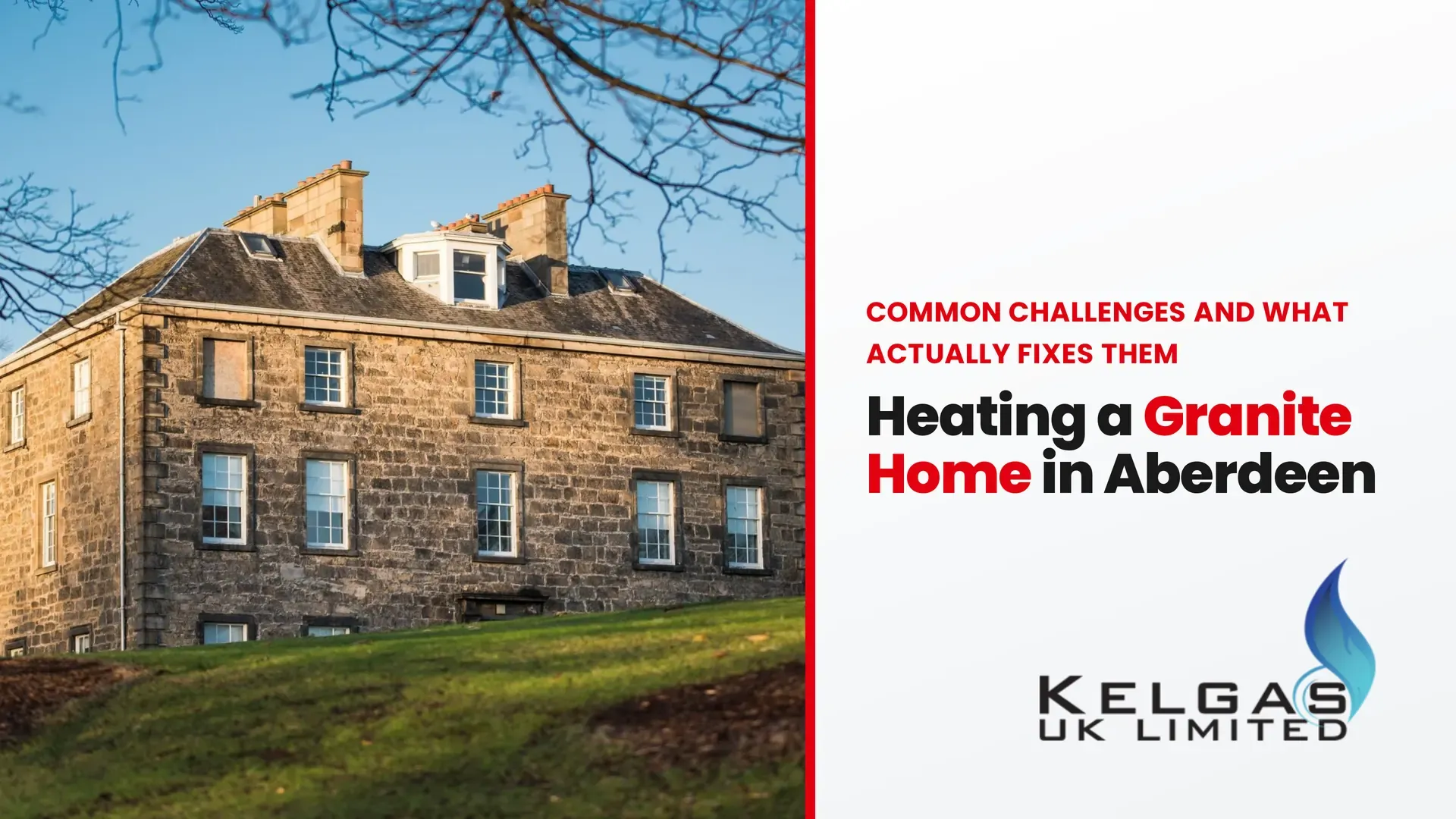
Granite built this city. From the tenements of Rosemount to the farmhouses outside Inverurie and Banchory, thousands of Aberdeen and Aberdeenshire homes have walls of solid grey stone, often 600mm thick. They look solid because they are. But granite behaves very differently from a modern cavity wall, and that changes how your heating should be designed, sized and run.
We’re a family-run heating business based in Cove Bay, and we work in granite homes every week. This guide covers the problems we see most often, why they happen, and what actually fixes them. No guesswork, just what works in a stone house in the North East.
Solid stone walls lose heat faster than most people expect. A 2025 Scottish Government study measured the walls of real stone homes, including granite properties in Aberdeen. The granite walls came out at around 1.3 to 1.5 W/m²K. A new-build wall in Scotland today is designed to be around 0.17. In plain terms, an uninsulated granite wall can let through several times more heat than a modern one.
There is a second effect. Granite is dense, so it holds a lot of heat once it warms up, and it takes a long time to get there. That is why a stone house can feel chilly for hours after the heating comes on, then stay pleasantly warm into the evening.
Most of the “my heating doesn’t work” calls we get from granite homes come down to three things:
The good news is that every one of these can be improved.
Short bursts of heating suit a well-insulated modern home. They rarely suit granite. If your heating comes on at 6am for an hour and goes off, the walls barely start to warm before it stops. The air heats up, the stone pulls that heat back out, and the room cools quickly.
What works better in most stone houses:
Customers are often surprised that running the heating for longer can cost about the same or less. A condensing boiler that runs at a low flow temperature condenses more of its own heat. A boiler cycling on and off at full blast wastes it. Our guide to cutting your heating bills without turning the heat off explains the controls side in more detail.

This is the single most common issue we find in older granite properties. A boiler should be sized to the heat the house actually loses, and each radiator sized to its own room. In practice, many stone homes have neither.
Here is what we see:
The fix is a proper heat loss calculation, room by room. When we quote a new boiler installation in Aberdeen, we measure each room, account for the wall type, windows and ceiling height, and size the system from there. In a granite home, getting this right makes more difference than the brand of boiler on the wall.
Ballpark 2026 prices for Aberdeen, before any grants:
| Work | Typical cost |
|---|---|
| Like-for-like combi boiler swap | £1,800 to £2,800 |
| System boiler with cylinder | £2,400 to £3,500 |
| Back boiler conversion | £3,000 to £4,500 |
| Additional or upsized radiator, fitted | £250 to £450 each |
We give you a fixed written quote after a free survey, so the price you see is the price you pay.
Many granite homes have heating systems that have been extended, patched and rerouted over 40 or 50 years. Long pipe runs through thick walls, microbore pipe added in the 1970s, and old radiators mixed with new ones all create problems.
The usual signs are:
Aberdeen has soft water, so limescale is not really the local issue. The problem in older systems is corrosion. Steel radiators slowly rust from the inside, producing a black magnetic sludge called magnetite that settles in the lowest points. In a big stone house with long pipe runs, there are plenty of places for it to collect.
A power flush clears it out, and a magnetic filter and fresh inhibitor keep it from coming back. In Aberdeen a power flush typically costs £300 to £550 depending on the number of radiators. If you are not sure whether your radiators need one, our article on what your radiator is telling you walks through the symptoms.
Stone walls work best when they can “breathe”. Traditional stone and lime construction lets moisture move through the wall and dry out. Historic Environment Scotland’s advice is clear: any insulation or finish you add to a stone wall must not trap that moisture, or you risk damp and decay.
This matters for heating because damp walls are cold walls. Wet stone loses heat faster than dry stone. If you have black mould in corners, peeling paint or a musty smell, deal with the moisture first.
Sensible steps we recommend:
Insulation is not our trade, so we would point you to a specialist for the wall itself. What we can do is make sure your heating is designed around the house you have, before and after any upgrades.
Stone homes are exactly the kind of property Scottish grants are designed for. Home Energy Scotland Grant and Loan offers solid wall insulation funding of up to £7,500 grant plus an optional £2,500 interest-free loan, with an extra uplift for rural and island homes. It is open to owner-occupiers with no benefits test.
There is one catch worth knowing: Home Energy Scotland does not fund a new gas boiler. The only scheme that can fit one is Warmer Homes Scotland, which is means tested. We cover the details, including the rural uplift and how to apply, in our heating grants Scotland 2026 guide.
If you plan to insulate, tell us when we survey. A house that is about to lose much less heat may need a smaller boiler than the one you have now, and it is far cheaper to size it correctly once.
Before the worst of the cold arrives, run through this list:
We’ve worked on granite tenements in the city centre, stone cottages in Oldmeldrum and Blackburn, and big Victorian villas in the West End. Every one needs a slightly different approach. Our engineers are Gas Safe registered (547324), directly employed, and used to running pipe through walls that are thicker than a modern house is wide.
When we look at your home, we look at the whole system: the boiler, the radiators, the controls and the walls they are heating. Then we give you a clear recommendation and a fixed price.
If your granite home never feels quite warm enough, or your heating bill seems out of proportion to the comfort you get, give us a call on 01224 961610, text 07897 012244, or get in touch online. We’ll come out, take a look and tell you honestly what will make the biggest difference.
Find all of our reviews on Google, Facebook and Trustpilot.